A Pilates certificate can mark an important beginning. It does not automatically mean you feel ready to teach.
Many newly certified instructors know the names of exercises and can recall a sequence, yet still wonder: How do I adapt this for the person in front of me? What should I notice first? How can I offer a correction that helps a client understand and move with more confidence?
These questions are not a sign that you chose the wrong career. They point to the difference between learning a curriculum and developing the judgement to teach.
In our beginner’s guide to building real core strength with Classical Pilates, we explored how the method develops control and self-awareness in the student. The same principles matter in teacher education. To guide another person toward greater awareness, you need more than a collection of exercises. You need practice, observation, individual feedback and time.
A certificate is a starting point, not the whole preparation
Pilates certification pathways vary. The title certified instructor does not, on its own, explain how much Matwork training, supervised teaching or individual assessment a program includes.
That variation is worth taking seriously, without assuming every shorter program is poor or every longer one is excellent. A program’s quality depends on what you learn, how you practise, and how closely your teaching is observed, not simply the certificate name or total hours.
The National Pilates Certification Program (NPCP) provides one useful reference point. Its published requirements for comprehensive certification, effective January 1, 2027, specify a minimum of 450 hours and coverage of Mat, Reformer, Trapeze Table or Cadillac, Wunda Chair, Ladder Barrel, Spine Corrector and Magic Circle. The requirements also address teaching techniques, modifications, contraindications, special populations, observation, practice teaching and self-practice. Review the NPCP requirements.
Hours matter. But the way those hours are spent matters just as much. Coursework, personal practice, observation and supervised teaching are distinct learning experiences. A clear program should tell you what each category includes and how your growing competence is assessed.
Why teachers can still feel unprepared
1. Knowing the repertoire is not the same as knowing how to teach
Learning an exercise means understanding its shape, purpose and place in a sequence. Teaching it means noticing how a specific person is moving, choosing useful language, and adjusting your approach when the movement is not working for them.
That takes practice beyond memorizing cues. You need to learn to observe, to decide what matters most, and to offer an instruction the client can actually use. Sometimes the best teaching choice is a smaller movement, a different setup or a pause to clarify what the person is experiencing.
A strong teacher does not simply deliver the sequence. A strong teacher helps the student understand it.
2. A heavy focus on apparatus experience narrows your view
A program with a strong focus on the Classical Matwork exercises will provide you with the essential architecture of the Pilates Method. Training that focuses on the apparatus may leave you less familiar with a fundamental distinction: how the different equipment connects the body to the overall work and how the springs change a movement’s demands. The Reformer, Cadillac, Chair and barrels each have their own setups, spring choices and teaching considerations. Starting from a clear framework that includes a concise understanding of the Matwork will deepen your skill set. Rather than relying on the apparatus to dictate how you teach, good teachers learn to use the Matwork as a diagnostic tool, a lens: it reveals what strength the student actually has and the apparatus is chosen to serve, challenge and connect with that body. Results are powerful long-term and immediately felt.
The aim in Classical training is not to collect equipment knowledge for its own sake. It is to develop a more complete understanding of the whole system and the choices available to you as a teacher, whether you are working in a fully equipped studio or not.
At rhṓmē Contrology Studio in Vancouver, our studio is equipped with Balanced Body Contrology and Gratz Pilates apparatus. Working with equipment in person gives a teacher the chance to study its details, practise transitions and understand how precise setup supports clear instruction.
3. Practice teaching needs thoughtful feedback
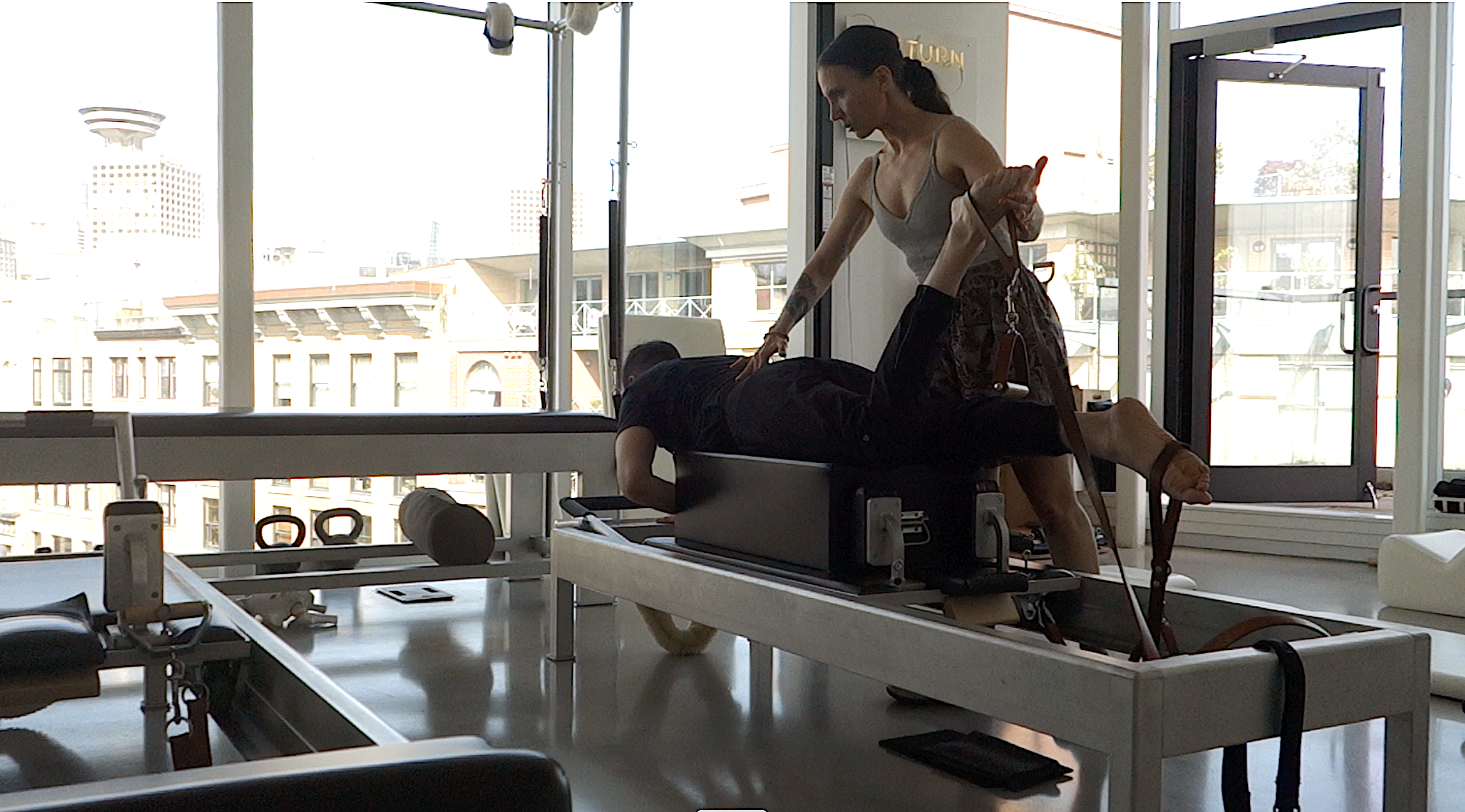
Teaching practice gives you a place to bring ideas into the room. Mentorship refines that practice.
A mentor can help you develop your "teaching awareness": whether your approach or cueing makes sense, whether you are understanding the movement, and whether your exercise choice fits the student’s needs. They can also help you refine your "voice", help you understand sequencing, safety and the balance between speaking and allowing someone to feel the movement.
Feedback works best when it is relevant, clear and repeated, if necessary. One practical correction, followed by another opportunity to teach, can help you turn a concept into a solid skill.
Mentorship in practice
4. A generic curriculum cannot prepare you for every student
No training program can give you an answer for every person who will walk into your midst. Your clients will bring different movement histories, abilities, goals, restrictions and questions.
A considered education gives you a framework for responding. It helps you build a foundation in anatomy and movement, understand progressions and modifications, and recognize when something falls outside your scope. It also helps you stay curious rather than reaching for one sequence as the answer for everyone.
That kind of judgement grows through study and experience. It is not a shortcut, and it does not need to be.
What makes classical Pilates teacher training meaningful?
“Classical Pilates” has become a familiar marketing phrase. Not every class or training program using the label offers the same depth, structure or teaching approach. It is worth looking beyond the name and asking what the education actually involves.
Comprehensive Classical Pilates teacher training asks you to study the system as a connected practice: the repertoire, its progression, the apparatus and the teacher’s role in guiding each student. But an orderly sequence alone is not enough. The teacher must learn to see the human body within it.
This is where Contrology carries a distinctive purpose. It is not only about a teacher directing a student through "a workout sequence". It is about empowering the student to develop self-awareness: to help them understand what they are doing, notice how they move and, over time, work more independently. Having the skills to provide your students with this is the most promising, most powerful tool a teacher can give a student.
That purpose changes the way you teach. You offer a cue not simply to make a movement happen, but to help the person recognize and organize it for themselves.
The aim is not dependence on the teacher. It is growing understanding in the student.
Questions to ask before choosing a program
When you compare a Pilates certification or teacher training, ask for details that show how learning happens in practice:
What is the total program length, and how are the hours divided between coursework, personal practice, observation and teaching?
Which apparatus and levels of the repertoire are included?
How much teaching practice is supervised, and who provides that supervision?
How will instructors assess my teaching, not just my written knowledge?
What feedback will I receive, and how can I apply it before the next assessment?
How does the program address anatomy, modifications, contraindications and different client needs?
What support is available after the formal training is complete?
A thoughtful program will welcome these questions. You are choosing an education that will shape your work with people, so it makes sense to understand how the process supports your growth.
From certification to confident, considered teaching
At rhṓmē Contrology Studio, our comprehensive teacher training is designed as a deeper course of study. The course is a 600-hour program covering Mat, Reformer, Chair, Trapeze and Barrels, from Introduction to Intermediate, with online and in-person learning. Completion generally takes approximately 10 to 18 months, depending on the individual. Program details, including the course structure and costs, are provided after an intake interview with the studio.
For graduates of a recognized Pilates teacher training program, our mentorship program offers a next step to bring prior learning into practice. The focus includes functional anatomy, movement science, teaching pedagogy, personal practice and the craft of teaching.
Our studio’s approach draws on nearly three decades of combined coaching, clinical rehabilitation and Pilates experience. The intention is not to promise instant confidence. It is to offer a setting where you can keep learning, receive thoughtful guidance and build skill with care and purpose.
If you are considering Classical Pilates teacher training or mentorship in Vancouver, we invite you to explore the program and contact us with your questions. A clear conversation can help you understand whether the next step fits your experience and aspirations.
Your certification may open the door. What you practise, how you are guided and the attention you bring to each student help you grow into the teacher beyond it.
Learn Pilates. Practise Contrology. Teach with skill.